Flying house model from Pixar movie Up

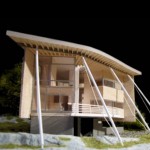
Here you have the most recent addition to my model collection. This is N-scale scratchbuilt model of flying house from the new Pixar movie “Up”. I haven’t seen the movie yet (still not open in cinemas in Ireland) but I loved the trailer and this colorful piece of architecture. I needed to have it in real 3d… The design was simple, I based on pictures, movies from youtube and cut out toy from official Disney Pixar website. I started last Friday, all parts were ready on Saturday. It was going to be weekend project. So far its two weekends project and I am not yet satisfied with my paint job. I will post more photos from different angles later.

I was asked by people from forum pixarplanet.com how was it made and blueprints. Here are my drawings with all of my parts to give you better idea what was involved in process of creating it.
First drawing is prepared to be cut on 1.5mm cardboard. The blue lines are cut to 0.5 mm, yellow is the engraving of panels on the door. I glued the parts together, I prepared little holes and joints, so all walls are at right angles and in exact positions and its quite rigid construction.
Second page is cut on 0.5 paper. Its another layer to cover joints and create window frames. I engraved the boards on the walls, but later decided that I want better 3d effect, so I covered it with overlapping stripes of paper.
Last page is with 3 types of shingles and boards for wall and is cut out of 0.3mm paper. If you have any questions, feel free to ask on my email or post a comment.
FOW terrain update

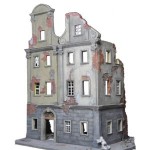
Here you have few photos of my weekend project. I prepared my drawings a while ago, and decided to cut it now. It is my new master for resin casting. Its made of cardboard, bricks and some war damage is engraved on surface. I will patch few places with putty, add more cracks and texture to plaster, add some details like broken glass, timber joists and a little plush teddy bear on the floor
Then I will sand it in some places, prime it and its ready for silicone mould. Anybody wants one?

Its all laser cut from 1.5mm and 0.5mm cardboard. Bricks are made in two passes : first is engraving for about 0.4mm deep, then mortar line is cut for another 0.4mm. Floors are cut from one 1.5mm cardboard (the shape with joists) than on top of it is a 0.5mm paper layer with timber boards. Bottom side is again timber boards and another layer with peeling plaster ceiling.

Paint in progress

All of my moulds are finished. This is my first cast assembled. It is painted with base colours. It will take a lot of time to paint and weather it. I will describe this process later in short tutorial.

N-scale church update

Most of my parts are already done. This is my first cast assembled and primed white. You see here 9 main parts and another 8 small details. I need to pour the silicone on 2 more pieces and I can finish this model.


Flames of War

I cut this elevation few weekends ago. My friend from university sent me his survey drawing of this beautiful tenement-house in Poland. I thought it may be a nice element for the wargame table or diorama. I am going to make damaged version of this building in the near future. It will be in scale 1:100 to fit the Flames of War figures.

Round Tower

This is my favourite part of the building. I think that asymmetrical tower captured my attention when I was passing by that church. It has 8 little columns on the perimeter and looked complicated at first moment, but it was very easy to make.
I started with 50 cross sections laser cut in 1.5mm cardboard. Then filled spaces between pillars with green stuff and sculpted stone. It will be primed later and cast as single resin part.

Micro manufacture

Those are my first casts of 3 finished parts. I used polyurethane Axson F16 resin. Very quick de-moulding time (2.5m pot life, de-mould 20 – 30 minutes). It has low viscosity so it flows like water to all details. Silicone mould rubber T20. Its hard to get those materials here in Dublin so I ordered it at http://www.tiranti.co.uk. It arrived quickly and well packed. The bad surprise was delivery cost over 20£ for 4 kg parcel.

Saint Bartholomew Church in Dublin WIP

This is the project I am working at the moment. It is Saint Bartholomew Church on the Clyde Road located in Balsbridge in Dublin. When I first saw this building few months ago, something captured my attention. Was it the location? Its stands on the triangular land surrounded by red brick houses converted to embassies. Hard to believe that when it was built in 1867 it was open fields.

The church was designed by an English architect, Thomas Henry Wyatt in a Gothic Revival for Sidney Herbert, of the Earls of Pembroke. The original design was never completed, the unusual octagonal tower never received its intended spire.

I am building the laser cut cardboard master in scale 1:160 (N scale). I am going to make moulds of finished pieces and cast it in resin. I will see how many copies my moulds can handle. I will offer them on eBay sometime in future. That will be very limited edition. If anyone is interested, send me an e-mail: architecturalmodelmaker@gmail.com or check this blog to see the progress.
Jubilee Church

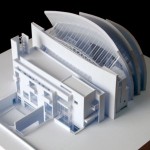
First model I would like to present you is Richard Meier’s Jubilee Church I made last year. Plan-form and section are extremely clear. Three circles of equal radius create three concrete shells to the south and together with a thick spine wall to the north. The west (altar) and east (organ) walls are light glazing, surrounding the bright, white set pieces for the cross and organ respectively. Natural light is the major theme, with skylights between each shell and over the main space, creating ever changing patterns within. In a contrasting, plain L plan around a sunken courtyard, is the community centre, on four levels. The centre is separated from the main church by a linear top-lit atrium.

The whole model is hand cut from styrene. That was before I bought my laser plotter. The shells were vacuum formed or rather pushed on my clay mould I prepared especially for that. At the beginning I was going to laminate it with glass fibre and resin, but I decided that styrene will be easier to cut later. Each shell contains 2 sheets of formed styrene and few stripes in the middle to add the necessary thickness. Then I sanded the edges and engraved the mesh of panels divisions. The rest is pretty straight forward. The most time consuming was engraving (panels, paving and railings).

Everything is lit with around 40 LEDs and it serves as the “mood” light in my bedroom
It better than “lava lamp”.